Big Ten commish says 24-team playoff would make regular season more meaningful, not less
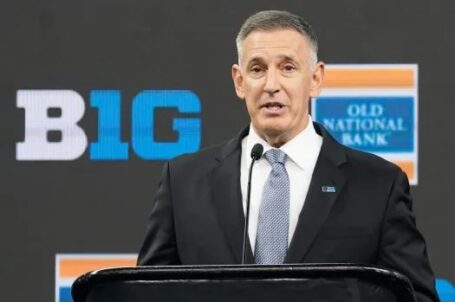
Meeting with reporters at the Big Ten spring meetings in Rancho Palos Verdes, Tony Petitti says he’s surprised he keeps having to explain his opinion to a stout group of critics who favor a smaller expansion.
Big Ten Conference commissioner Tony Petitti is surprised that he has to keep explaining his stance that expanding the College Football Playoff from 12 to 24 teams would make the regular season more meaningful, not less. (AP Photo/Darron Cummings)
Eddie Pells (AP) — RANCHO PALOS VERDES, CA — Big Ten commissioner Tony Petitti painted his conference’s 24-team College Football Playoff proposal as a way of making the regular season more meaningful – not less – and said he’s surprised he keeps having to explain that to a stout group of critics who favor a smaller expansion.
“When I was in baseball, we never had to convince people that keeping more people in the race is better for everybody,” Petitti, who helped shepherd in playoff expansion when he was with Major League Baseball from 2008-20, said Tuesday. “But I feel like, in this space, we’re being asked to do that.”
Petitti met with reporters on the second day of the league’s spring meetings. He spelled out the reasoning behind the push for a 24-team playoff and projected a sense of unanimity among his coaches and athletic directors in favor of doubling the tournament from its current 12-team format.
He once again said there was no real love in his league for what the SEC prefers – a move to 16 teams that, under one scenario, would put every playoff team in action on the first week.
“I don’t understand the motivation to play a championship game without a bye,” he said.
But, Petitti asked, if leagues got rid of the title games, then in a 16-team format that adds only two games to the playoffs, “what’s the economics” to make up what he estimates is $200 million in revenue the Power Four conferences would lose?
Over the past few weeks, both the Atlantic Coast and Big 12 conferences have said they would prefer a move to 24 teams. “There is a deep commitment to 24,” Petitti said.
In what might have been the week’s biggest eye-opener, SEC commissioner Greg Sankey said on “The Paul Finebaum Show” that at his own league meetings in Florida next week, he expects “a lot of our coaches, a lot of our athletic directors and probably some others (will) think 24 is the right direction.”
That would mark a seismic shift from where the SEC has been for the past year.
Sensing the gulf between the SEC and his own league – the two conferences that must agree to a change – Petitti said the Big Ten shifted away from a model with multiple automatic qualifiers to one that would place 23 at-large teams selected by the committee into the new bracket, with one slot reserved for a Group of 6 program.
Games in the first two rounds would be played on campus. Early rounds played on home campuses would deliver substantial local ticket sales, concessions, and merchandise revenue directly to the hosting universities, departing from neutral-site bowl games.
Petitti said the system created enough “tiers” – with eight first-round byes, eight more first-round home games and the last eight spots going to teams simply looking for a playoff berth – to generate interest in regular-season games across the country, and down to the wire.
“I don’t get why we can’t have a Minnesota-Iowa game have a big impact every so often – or every year, actually,” Petitti said.
Because the leagues haven’t been able to agree, the upcoming season’s playoff will still be a 12-team affair. The ESPN deadline to decide about 2027 is Dec. 1.
Such a large single move literally doubling-expansion would involve a huge amount of logistical maneuvering, most important of which would be figuring out what to do with conference title games and selling the 12 new playoff games to the lucrative bidding block of TV partners such as Fox, ESPN, ABC, TNT, CBS and NBC. This would trigger massive new television contracts and ad revenue to help pay for radically increasing costs.
The bottom line: the college sports industry needs the money. Since we’re finally paying players a lot — and since we’re doing so while continuing to allow coaches’ salaries and buyouts to rapidly escalate — athletic directors are desperate to increase revenue wherever possible.
Expanding the CFP from four to 12 teams added more than $700 million in annual college sports revenue, but everyone needs even more, and no one wants the boosters who are writing the big checks to feel unrewarded.
“I don’t understand the basic premise that more games that have an impact or keep you in the hunt isn’t the right thing to do,” Petitti insisted.
And as ACC Commissioner Jim Phillips said last week, “If you’re going to ask presidents and chancellors and boards to continue to invest in their football programs, it’s really important that they have hope, that they have an opportunity at the beginning of the season to get into the playoff.”
According to a memorandum of understanding that the conferences and Notre Dame signed in March 2024, the Big Ten and SEC must agree on a future playoff format for it to be adopted. SEC administrators gather next week near Destin, Florida, for their version of their annual spring meetings.
TrojanDailyBlog members — We always encourage you to add factual information, insight, divergent opinions, or new topics to the TDBthat don’t necessarily pertain to any particular moderator post or member comment.
SUBSCRIBE HERE TO RECEIVE NOTICE OF NEW COMMENTS OR REPLIES.
I was listening to Mark Kulkin. He was saying that Jamaal Jarrett was trying to become lean and mean by losing weight. He’s down to 350 right now with the goal of getting down to 330. He said that Floyd Boucard will be playing in the NFL eventually but Jarrett was actually quicker and more athletic than Floyd. He predicted that the starters on the D-Line this year will be Kam Crawford at edge, Boucard and Jarrett inside and Jakeem Stewart at the D-End on the other side. If Jarrett is as good as he says he is, that D-Line… Read more »
College Station Regional
(1)Texas A&M (39-13)
(2)Southern California (43-15)
(3)Texas State (36-24)
(4)Lamar (34-25)
Winner will likely face North Carolina in the Super Regional. USC has the highest RPI of the group. I like USC’s chances here but may have to take 2 of 3 from TAM.
Friday, May 29 ET
Texas A&M vs. Lamar | 4 p.m. | SEC Network
Southern California vs. Texas State | 9 p.m. | ESPN+
Curious that by rankings 7 Oregon State 43-12, 12 Arkansas 36-19 and 15 Ole Miss 36-20, do not get to host but 17 Florida37-18, 18 Alabama 37-18 and 21 Nebraska 41-14 do. Going by RPI, 9Southern California 43-15, and 16 Ole Miss 36-21 don’t get to host but 17 West Virginia 39-14 and 19 Kansas 42-16 do. If I was Ole Miss I’d be really pissed, in the top 16 in rankings and RPI but no host. Ole Miss, Oregon St, Arkansas and USC better get good seeds in weak regionals.
USC has no reason to complain, having lost so many of its most important games, including three of the last four. USC beat woeful MICH ST (24-32) but the Spartans didn’t even make the 64-team NCAA tournament. Not exactly impressive, especially considering we had maybe the best pitcher in baseball, Mason Edwards. USC went a combined 1-9 against ORE, UCLA and NEB, often losing by lopsided scores when it mattered. USC’s reg season and B1G tourney breakdown vs the teams hosting their own regionals: vs ORE (1-2): Won one of three games in Eugene (W 2-1 in 11 inn, L… Read more »
OK….They lost to UCLA again. I still say this has been a very successful season and it ain’t over yet. If they had won, they still have to play UCLA again if you look at the brackets and the Bruins would be very mad. If they can get to the Bruins one more time this season I think they have a chance to surprise people and win. If they lose again…..Rome wasn’t built overnight
Ya, you would think USC could at least beat UCLA once in five tries. UCLA is a great team. USC isn’t, by a long shot.
No shame in losing to these Bruins again. Even when we were ahead going into the bottom of the 9th, I didn’t think we’d win. Sure enough, we lost by two.
You said “Even when we were ahead going into the bottom of the 9th, I didn’t think we’d win”. That’s their problem. At this stage in the game, they don’t yet have the mentality that tells them that they will win. That championship mentality has to be developed. I think it will be. I like this coach.
USC is not great but good. After yesterday D1Baseball has them at 25. You lose to the #1 team in the country and drop from #17 to #25? UCLA is 1, Oregon at 14 and Nebraska at 20. RPI for these 4 is #1 UCLA, #9 USC, #10 Nebraska, and #15 Oregon. The Selection Show is tomorrow for 64 spots, where will USC go? With 16 regionals I guess the top 16 are the hosts? How will the Big10 do against the Southeast teams?
Only eight teams make it to the college world series. I doubt USC will be in that group, but as you say, anything can happen. Even “crazy.”
The Trojans haven’t made it to the CWS in 25 years. Seems like karma should be on our side by now.
I think Stanky should have put in Mason Edwards for the final inning yesterday. Why not? He only pitched four shut-out innings against the Spartans the day before.
Actually, we lost four times, not 5. But the issue is right now ucla knows how to win those type of games, and we don’t. That is what separates us from the few elite teams. A work commitment forced me to miss the last two innings, which is just as well, because I would have hated to few this is real time on TV. And like you Allen, O was just waiting for the bruins to make the game winning play, and never thought we would win. Our regional is going to be an uphill climb, but Edwards/Govel give us… Read more »
007 was speculating that USC could finally beat UCLA in a fifth game between the two. Just for clarification’s sake, I never said USC lost to UCLA five times. I didn’t mean to even suggest that, and was just expressing the idea/hope that it’s about time we won in our next matchup — since losing four straight to the Bruins is bad enough as it is. 😪 You’re lucky you missed the bottom of the ninth PN4SC. It was like UCLA was just toying with USC to torture us with a final heartbreaking walk-off, two-out win. Yuk. But that’s the… Read more »
“this Bruin team is a pleasure for even me to watch”, except those reverse Banana Ball uniforms they had on yesterday! Are they going full Banana Ball unis today?
No. Today they’re wearing their whites, and tied with ORE 0-0 in the bottom of the 4th. But with this UCLA team, I always get the feeling the dam is about to burst.
I stand corrected about the 5 games. I don’t think this current Trojan team is championship caliber, but if we can mange the porta just OK, I think Stank can get us there, soon
Agreed. USC has come a long way under Stanky. But we still have a long way to go. It’s a long road. I think we’ll get there, assuming we can keep Stanky.
I wouldn’t mind seeing Savage retire too. He’s been at UCLA for 22 years now.
You said “You’re lucky you missed the bottom of the ninth PN4SC. It was like UCLA was just toying with USC to torture us with a final heartbreaking walk-off, two-out win. Yuk. But that’s the way it goes sometimes, especially if you are playing the Bruins these days, who have made it a habit of demoralizing teams”. Sounds like you are saying they like to toy with teams letting them go into the 9th inning with the lead and then break their hearts with a big inning and the win. Well, we’re probably going to play UCLA again this year. Please….Mr.… Read more »
No, that’s not what I meant at all. “Toying with us” in my context meant I think UCLA literally always knows or feels it will win most every single game. They hardly ever lose. They are amazingly cool and calm under pressure, which increases as a game goes on. They’re extra inning record is 3-0 this season, including today’s come-from-behind win over ORE when they tied the game in their last at bat. They are clearly so confident because they simply have a better all-around team and a proven national championship coach who is undoubtedly the best Bruin baseball coach… Read more »
Well if that’s what you meant then I have no problem with it. But let’s look at the facts. Whether they intended to toy with other teams until the 8th or 9th inning or not, the fact is that this is now 3 games in a row where they were either behind or tied going into the 9th inning. I didn’t even know about the Oregon game. You can’t continue to win that way. Sooner or later, the ball just doesn’t bounce right for you in the 9th. Lady Luck is a promiscuous lover. She isn’t always faithful to just… Read more »
It could simply be that the Ruin pitching staff can outlast their opponents pitching and then the offense comes on late against weaker pitching. If that makes sense.
That could be. Irrelevant!!! I don’t care what the reason is. I’m saying that if you continue to play this game of laying low in the early innings and then working your magic in the 9th inning you’ll soon pay a price.
UCLA’s the #1 team in the nation and has been literally all season long for a reason. Probably about 10 reasons, which is why they would still be ranked #1 even if they had lost the B1G tourney to ORE. They are one of the best college baseball teams I have ever seen, and it’s not because they win early, win late, or win in the middle. It’s because they are the deepest, most well-balanced, most talented, most confident, and best-coached team in the country. Can they lose any game against top flight comp? Of course they can. So can… Read more »
At the end of the second round of the Women’s NCAA Golf Championships, second place/#2 USC (-9) has fallen behind #1 STAN (-12) by three strokes. The Cardinal shot six under for the day in Carlsbad.
Koo needs to step it up, she’s 4 off the leader, tied for 15th. Park is 3 back and tied for 7th.. Shoemaker is also T15. Stanford has a player T1 and another at 3rd. Their 3rd player is T34, 6 shots back. With 2 more rounds a lot can happen still.
I’d think twice about offering Dylan Wafle. They have him listed as 6’1″ and 205. The height may be right but he doesn’t look like he’s 205. And he looks slow on film.SC is the only significant school that is offering him. He only has 5 offers
It’s USC vs BC. That’s all folks. The fact that he is a “perceived lock” to USC could be at least a partial reason for this, but I agree, he looks underwhelming.
40% of NFL’s 32 teams make the playoffs. CFB has 138 FBS programs or so. 24 teams into the playoffs is about 18%. I’m starting to think this expansion to 24 over 12 makes sense. Lots of teams finally have hope of getting into the playoffs and having a lot more fun all season long. That’s just better for the game. In the past, if you lost a couple of games, especially big ones, your party in CFB was basically over. For the elite teams, that was great. For everyone else, it sucked. Why not reward teams that are improving… Read more »
The truth is, CFB has never been more popular. At least that’s what the ratings show. Why not spread the wealth a little bit? Give everyone a better shot.
The more the merrier. Who knows? Maybe even the Hoosiers will win a national championship in football some day.
10% chance of that I would say. Better than nothing. Stanky’s done a great job. But this UCLA team may be the deepest team in NCAA history. At least that’s what they are saying. UCLA would just have to have a “very off” day. It happens.
Ya, they only won 48 (.889), and went 28-2 (.933) in the B1G.
Overwhelming #1 seed UCLA plays #5 PUR at 4 pm PT. Should be a slaughter and a nice little tune up tomorrow for USC who they’ve already beaten 12-4, 9-8 and 10-4.
Do you really give USC more than a 10% shot here? The Trojans already went with their #1 guy Mason Edwards today.
I’m not talking about “crazy.” I’m just talking about odds.
I hate having to admit this, but you are right about ucla. They do everything well, no weaknesses. I am hoping since we have more to play for, maybe SC will want it more. On pure talent, they are way better. Love Coach Stank
Well Allen, I’m turning in my homework assignment. It’s a bright clear morning (with new lenses in my eyes) so I’m feeling optimistic. LR steps up and finally becomes the coach we thought he would be (with help from GP). Guys that got playing time last year will step it up to another level. 3 or 4 of the freshmen as well as 2-3 of the transfers make big contributions. So here goes. 1. Will USC make the 12-team playoff? Yes at 10-2. 2. If so, how far will we go? As the 5 seed they get an easy win at home then lose to the… Read more »
I see two games that USC may struggle to win, but could, that is tOSU and Indy at Indy. If they win one of those its on, they could go all the way. PSU needs a year or two to get dialed in to the new coaching. They did lose a lot of players.
Matt Campbell will be a tougher coach to beat in Beaver Stadium than big game loser, overly stale James Franklin, whom everyone at PSU was simply sick and tired of. Campbell brought over 24 of the best players from IA ST and a total of 39 from the portal. PSU will be a very interesting, hard-to-predict and prepare for team, but solid for sure. I think they are going to be a tougher team for USC to beat than you do for lots of reasons, including the fact the D’Anton Lynn probably knows USC and LR like the back of… Read more »
As far as D.Lynn knowing the “book” about SC, don’t you think our brilliant HC, Linkin’ Riley will change up his offense in this game and modify strategy accordingly with the personnel he has at his disposal?
Nah, what am I thinking? Riley won’t change a thing with his precious Big-12 offense Our head coach intern is a one trick pony who will continue to phone it in 2026. Why should he change? He already has generational money extending to his future great grandchildren.
Thanks for letting me put you on the spot GT. I think it’s fair to say you’ve laid out a great glass-half-full assessment of USC’s 2026 season. I’m probably leaning more towards losing three reg season games to OHIO ST, PSU and IU. Running up against D’Anton Lynn, an improvement but not great at USC, should be a big challenge based on how well he knows USC. And to lose only three reg season games, USC still has to figure out a way to finally handle higher-ranked ORE, a school which has hammered USC in recent years, including last season… Read more »
He’s recently on record saying he’s “a lot better coach” now than he ever was at OU. I guess LR was a lot worse than we all thought he was when OU was signing his checks.
I suppose all coaches who go through tough periods can say that because learning from one’s mistakes should be a huge factor in any person’s advancement.
Is Lincoln Riley even capable of winning a national championship at USC? History says no. Hope, especially after spring ball which often reveals very little with closed practices, says yes.
“LR steps up and finally becomes the coach we thought he would be”. I don’t know about that but I do think that he is a better coach than when he first came here. When he first came here he had no use for defense or special teams. He really thought he could go 15-0 and win the NC winning every game 50-49. Special teams were about as important to him as the cheer leaders. That seems to have changed. “Who will be USC’s MVP? Jayden Maiava.” I don’t know. He’s got a lot of great qualities. But his temperament… Read more »
What questions? You mean where he asks “Is Lincoln Riley even capable of winning a national championship at USC”? Yes….I think he is. That’s not to say that he’s going to but I think he’s capable.
Here they are: 1) Will USC make the 12-team playoff? 2) If so, how far will we go? 3) Who will USC lose to, both in the reg season and in the playoffs? 4) Who will be USC’s MVP? 5) Will Jayden Maiava have his best year as a Trojan and make the Heisman finalists in New York? 6) Will USC’s D become one of the best in the B1G this season in terms of points allowed? 7) Which USC freshman from the prep ranks will play the most? 8) Will LR get fired if USC misses the playoffs,… Read more »
1) Yes, they should make it even though they have a tough schedule. A tough schedule should help them to make it when the committee chooses it’s teams. 2) How Far? It’s hard to say. If the ball bounces their way, they could go a long way. They have everything they need. A great OC….a hall of fame DC and a lot of star players and they are usually hard to beat at home where they play Oregon, Washington and Ohio State and UCLA is really a home game too, even though they play at the Rose bowl. 3) A… Read more »
Since we both agree neither of us are Nostradamus by a long shot, here’s what AI came up with for the five freshman most likely to make the biggest 2026 impacts. Pretty interesting I thought: Luke Wafle (Edge Rusher): The five-star recruit and former top-rated prospect from New Jersey graduated early to enroll for the spring. He turned heads in spring practice with his grit and physical effort, positioning himself for immediate rotational snaps. Mark Bowman (Tight End): A massive five-star local talent out of Mater Dei, Bowman possesses rare physical gifts. He is projected to become a significant weapon… Read more »
Keenyi Pepe is an offensive lineman. OL’s usually take about a year to develope their skills. Sometimes they start as a true freshmen but that is usually on a team that has a poor O-Line. But he probably will get playing time. I should have included him. Tron Baker is a surprise to me. Up until training camp I thought he was a wasted scholarship. Shows you how much I know. But I don’t think he will get much PT next year. Madden Riordan not only has a nose for the football but he must have great accelleration and recovery… Read more »
Super Recruiter Ed O heads back to LSU 2019 NC-winning HC Ed Orgeron is returning to LSU after being fired in 2021 ($17.1 mil buyout) to join long-time friend Lane Kiffin’s staff as a special asst (recruiting and defense). “I’m excited to bring Coach Orgeron back to LSU,” Kiffin said. “He brings us tremendous value with his ability to recruit elite players nationally, but especially the impact he can have for us recruiting the great state of Louisiana. “Coach O understands my expectations and commitment to being a championship program. I look forward to seeing him with recruits and his… Read more »
He’s an outstanding position coach. We should have hired him as our D-Line coach. There’s nobody better to coach the D-Line and what a recruiter. I’m sure he would have loved to come back to SC.
Army-Navy is great spectacle but not great football anymore. Harvard-Yale is ancient history, minor league football, nice for them but who else cares. I would take both games out. . USC-UCLA both will have to get relevant again. ND-USC will have to start up again. How about Alabama-LSU, FSU-Fla., FSU-Mia, ND-Mia, Utah-BYU?
So looks like the 24 team playoff is a done deal. So looking at the week 16 CFP rankings, here is how the ’25-’26 CFP would have gone (according to me 😉: 1ST ROUND 24 JMU at 9 Alabama 23 Iowa at 10 Miami 22 Geo Tech at 11 Notre Dame 21 Houston at 12 BYU 20 Tulane at 13 Texas 19 Virginia at 14 Vanderbilt 18 Michigan at 15 Utah 17 Arizona at 16 USC Alabama, Notre Dame and Texas get the cupcakes, the other home teams with all their stars opting in to the game likely win and… Read more »
From beating up on cupcakes to being the cupcake. Won’t it be grand to beat up on the elites again? What are your predictions for this season GT? Come on. Give it your best shot. 1) Will USC make the 12-team playoff? 2) If so, how far will we go? 3) Who will USC lose to, both in the reg season and in the playoffs? 4) Who will be USC’s MVP? 5) Will Jayden Maiava have his best year as a Trojan and make the Heisman finalists in New York? 6) Will USC’s D become one of the best in… Read more »
Give some slack Allen, my man! It was enough for me to put that mock playoff together. Today I’m recovering from 2nd cataract lens replacement in 2 weeks. Doing well but groggy from the good juice the anesthesiologist gave me. First time in my life, no glasses! I will think on your questions. Generally I will go with 3 assumptions, LR will be the best LR this year that we have seen so far, the guys who were unsung 2nd stringers last year will rise up and 2-3 freshmen will shine.
Mark Sanchez’s Indianapolis jury trial was originally scheduled for March 12, but it has been rescheduled three times. The latest continuance moved the trial from from May 28 to July 13.
Sanchez’s most serious charge is battery resulting in serious injury, a Level 5 felony. The maximum penalty facing Sanchez is a six-year prison sentence and a fine of up to $10,000.
Mark Sanchez’s altercation in Indianapolis occurred just after midnight on Oct 4, 2025.
Ryan Kartje (LAT) —USC baseball locked up the fourth seed in the Big Ten tournament. But what about hosting a regional? The Trojans managed to take one of three against Oregon to at least lock up a bye until Friday in the Big Ten tournament. But right now, USC is likely on the outside looking in at hosting its first NCAA regional since 2002. All that could change with a run in the Big Ten tournament. Doing so, though, probably means pulling off an upset of No. 1 UCLA. If USC wins its first tournament matchup against whomever emerges out… Read more »

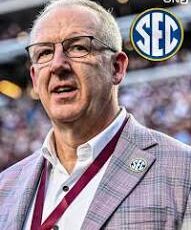 In what might have been the week’s biggest eye-opener, SEC commissioner Greg Sankey said on “The Paul Finebaum Show” that at his own league meetings in Florida next week, he expects “a lot of our coaches, a lot of our athletic directors and probably some others (will) think 24 is the right direction.”




























I was listening to Mark Kulkin. He was saying that Jamaal Jarrett was trying to become lean and mean by losing weight. He’s down to 350 right now with the goal of getting down to 330. He said that Floyd Boucard will be playing in the NFL eventually but Jarrett was actually quicker and more athletic than Floyd. He predicted that the starters on the D-Line this year will be Kam Crawford at edge, Boucard and Jarrett inside and Jakeem Stewart at the D-End on the other side. If Jarrett is as good as he says he is, that D-Line… Read more »
College Station Regional
(1)Texas A&M (39-13)
(2)Southern California (43-15)
(3)Texas State (36-24)
(4)Lamar (34-25)
Winner will likely face North Carolina in the Super Regional. USC has the highest RPI of the group. I like USC’s chances here but may have to take 2 of 3 from TAM.
Friday, May 29 ET
Texas A&M vs. Lamar | 4 p.m. | SEC Network
Southern California vs. Texas State | 9 p.m. | ESPN+
INDIANAPOLIS – The NCAA Div I Baseball Championship Subcommittee announced the 16 regional sites for the 79th annual NCAA Division I Baseball Championship. The 16 regional sites, host institutions and records: Athens, Georgia – Georgia (46-12) Atlanta, Georgia – Georgia Tech (48-9) Auburn, Alabama – Auburn (38-19) Austin, Texas – Texas (40-13) Chapel Hill, North Carolina – North Carolina (45-11-1) College Station, Texas – Texas A&M (39-14) Eugene, Oregon – Oregon (40-16) Gainesville, Florida – Florida (39-19) Hattiesburg, Mississippi – Southern Mississippi (43-15) Lawrence, Kansas – Kansas (42-16) Lincoln, Nebraska – Nebraska (42-15) Los Angeles, California – UCLA (51-6) Morgantown,… Read more »
Curious that by rankings 7 Oregon State 43-12, 12 Arkansas 36-19 and 15 Ole Miss 36-20, do not get to host but 17 Florida37-18, 18 Alabama 37-18 and 21 Nebraska 41-14 do. Going by RPI, 9 Southern California 43-15, and 16 Ole Miss 36-21 don’t get to host but 17 West Virginia 39-14 and 19 Kansas 42-16 do. If I was Ole Miss I’d be really pissed, in the top 16 in rankings and RPI but no host. Ole Miss, Oregon St, Arkansas and USC better get good seeds in weak regionals.
USC has no reason to complain, having lost so many of its most important games, including three of the last four. USC beat woeful MICH ST (24-32) but the Spartans didn’t even make the 64-team NCAA tournament. Not exactly impressive, especially considering we had maybe the best pitcher in baseball, Mason Edwards. USC went a combined 1-9 against ORE, UCLA and NEB, often losing by lopsided scores when it mattered. USC’s reg season and B1G tourney breakdown vs the teams hosting their own regionals: vs ORE (1-2): Won one of three games in Eugene (W 2-1 in 11 inn, L… Read more »
UCLA (51-6) comes from behind to beat ORE (40-16) 3-2 in the 11th inning to win the B1G tourney on a bases loaded hit batter walk-in.
At least the Bruins aren’t just picking on USC. They do this to everyone.
I couldn’t lose here as I always love to see both the Bruins and the Ducks lose.
UCLA magic continues, for now.
UCLA comes back to tie ORE 2-2 with one out left in the bottom of the 9th!
Extra innings coming up to determine the B1G Tournament champion.
OK….They lost to UCLA again. I still say this has been a very successful season and it ain’t over yet. If they had won, they still have to play UCLA again if you look at the brackets and the Bruins would be very mad. If they can get to the Bruins one more time this season I think they have a chance to surprise people and win. If they lose again…..Rome wasn’t built overnight
Ya, you would think USC could at least beat UCLA once in five tries. UCLA is a great team. USC isn’t, by a long shot.
No shame in losing to these Bruins again. Even when we were ahead going into the bottom of the 9th, I didn’t think we’d win. Sure enough, we lost by two.
You said “Even when we were ahead going into the bottom of the 9th, I didn’t think we’d win”. That’s their problem. At this stage in the game, they don’t yet have the mentality that tells them that they will win. That championship mentality has to be developed. I think it will be. I like this coach.
USC is not great but good. After yesterday D1Baseball has them at 25. You lose to the #1 team in the country and drop from #17 to #25? UCLA is 1, Oregon at 14 and Nebraska at 20. RPI for these 4 is #1 UCLA, #9 USC, #10 Nebraska, and #15 Oregon. The Selection Show is tomorrow for 64 spots, where will USC go? With 16 regionals I guess the top 16 are the hosts? How will the Big10 do against the Southeast teams?
Only eight teams make it to the college world series. I doubt USC will be in that group, but as you say, anything can happen. Even “crazy.”
The Trojans haven’t made it to the CWS in 25 years. Seems like karma should be on our side by now.
I think Stanky should have put in Mason Edwards for the final inning yesterday. Why not? He only pitched four shut-out innings against the Spartans the day before.
Actually, we lost four times, not 5. But the issue is right now ucla knows how to win those type of games, and we don’t. That is what separates us from the few elite teams. A work commitment forced me to miss the last two innings, which is just as well, because I would have hated to few this is real time on TV. And like you Allen, O was just waiting for the bruins to make the game winning play, and never thought we would win. Our regional is going to be an uphill climb, but Edwards/Govel give us… Read more »
007 was speculating that USC could finally beat UCLA in a fifth game between the two. Just for clarification’s sake, I never said USC lost to UCLA five times. I didn’t mean to even suggest that, and was just expressing the idea/hope that it’s about time we won in our next matchup — since losing four straight to the Bruins is bad enough as it is. 😪 You’re lucky you missed the bottom of the ninth PN4SC. It was like UCLA was just toying with USC to torture us with a final heartbreaking walk-off, two-out win. Yuk. But that’s the… Read more »
“this Bruin team is a pleasure for even me to watch”, except those reverse Banana Ball uniforms they had on yesterday! Are they going full Banana Ball unis today?
No. Today they’re wearing their whites, and tied with ORE 0-0 in the bottom of the 4th. But with this UCLA team, I always get the feeling the dam is about to burst.
I stand corrected about the 5 games. I don’t think this current Trojan team is championship caliber, but if we can mange the porta just OK, I think Stank can get us there, soon
Agreed. USC has come a long way under Stanky. But we still have a long way to go. It’s a long road. I think we’ll get there, assuming we can keep Stanky.
I wouldn’t mind seeing Savage retire too. He’s been at UCLA for 22 years now.
You said “You’re lucky you missed the bottom of the ninth PN4SC. It was like UCLA was just toying with USC to torture us with a final heartbreaking walk-off, two-out win. Yuk. But that’s the way it goes sometimes, especially if you are playing the Bruins these days, who have made it a habit of demoralizing teams”. Sounds like you are saying they like to toy with teams letting them go into the 9th inning with the lead and then break their hearts with a big inning and the win. Well, we’re probably going to play UCLA again this year. Please….Mr.… Read more »
No, that’s not what I meant at all. “Toying with us” in my context meant I think UCLA literally always knows or feels it will win most every single game. They hardly ever lose. They are amazingly cool and calm under pressure, which increases as a game goes on. They’re extra inning record is 3-0 this season, including today’s come-from-behind win over ORE when they tied the game in their last at bat. They are clearly so confident because they simply have a better all-around team and a proven national championship coach who is undoubtedly the best Bruin baseball coach… Read more »
Well if that’s what you meant then I have no problem with it. But let’s look at the facts. Whether they intended to toy with other teams until the 8th or 9th inning or not, the fact is that this is now 3 games in a row where they were either behind or tied going into the 9th inning. I didn’t even know about the Oregon game. You can’t continue to win that way. Sooner or later, the ball just doesn’t bounce right for you in the 9th. Lady Luck is a promiscuous lover. She isn’t always faithful to just… Read more »
It could simply be that the Ruin pitching staff can outlast their opponents pitching and then the offense comes on late against weaker pitching. If that makes sense.
That could be. Irrelevant!!! I don’t care what the reason is. I’m saying that if you continue to play this game of laying low in the early innings and then working your magic in the 9th inning you’ll soon pay a price.
UCLA’s the #1 team in the nation and has been literally all season long for a reason. Probably about 10 reasons, which is why they would still be ranked #1 even if they had lost the B1G tourney to ORE. They are one of the best college baseball teams I have ever seen, and it’s not because they win early, win late, or win in the middle. It’s because they are the deepest, most well-balanced, most talented, most confident, and best-coached team in the country. Can they lose any game against top flight comp? Of course they can. So can… Read more »
The scary thing is I thought I heard one of the announcers Saturday that next year is supposed to be UCLA’s big season!
Now that’s what I call “crazy.” I hope you heard wrong. All this Bruin success is a little tough for me to take!
You’re preaching to the Choir. UCLA is a great team. I wouldn’t argue with that. I agree
UCLA strikes again.
They hit a two-out, three-run walk-off homer in the bottom of the ninth on the first pitch to win the game 7-5.
Poor Trojans. 27th come from behind win of the year for UCLA. They are 22-3 when the opposition scores first.
This Bruin team is easily one of the best I’ve ever seen in the history of college baseball.
Gotta hand it to the Bruins, who just won their 50th game of the season, and against USC to boot.
USC starts off the bottom of the ninth with a huge bad play, putting a Bruin on. Amazing.
Playing the Bruins is like playing with a rattlesnake. They can strike at any time, from the mound, in the field, or at bat.
We’ve left so many runners stranded.
Now up 5-4 — but the Bruins have three outs left to break USC’s heart yet again this season.
Losing this one would REALLY by cruel and unusual punishment!
At least when the HR hitter was interviewed he said…..on the field we are rivals….off the field they are a bunch of great guys.
USC up 1!
Top of the 9th….bases loaded…no outs….down 4-3.
At the end of the second round of the Women’s NCAA Golf Championships, second place/#2 USC (-9) has fallen behind #1 STAN (-12) by three strokes. The Cardinal shot six under for the day in Carlsbad.
Koo needs to step it up, she’s 4 off the leader, tied for 15th. Park is 3 back and tied for 7th.. Shoemaker is also T15. Stanford has a player T1 and another at 3rd. Their 3rd player is T34, 6 shots back. With 2 more rounds a lot can happen still.
I’d think twice about offering Dylan Wafle. They have him listed as 6’1″ and 205. The height may be right but he doesn’t look like he’s 205. And he looks slow on film.SC is the only significant school that is offering him. He only has 5 offers
Makes me wonder if they got Luke by offering the family a packaged deal. I could be wrong but his film is definitely underwhelming.
It’s USC vs BC. That’s all folks. The fact that he is a “perceived lock” to USC could be at least a partial reason for this, but I agree, he looks underwhelming.
Well, well, well…
PUR leads UCLA 3-1 with two innings to go.
UCLA hits what looks like a two-run homer in the 8th to tie the game 3-3.
But even though it was called a two-run homer, on replay it was ruled not a homer and the score was changed to 3-2.
UCLA then singles to tie the game 3-3. Four consecutive hits for the Bruins after getting only two hits in the first seven innings.
3-3 heading into the 9th.
PUR totally falls apart with back-to-back errors and loses 4-3.
The #2 USC women (-7) are kicking butt today at the NCAA Golf championships.
They lead #1 STAN by one stroke after one round in Carlsbad.
ARK (-3) and OKS (-5) trail. #3 UF and #4 A&M are way back.
40% of NFL’s 32 teams make the playoffs. CFB has 138 FBS programs or so. 24 teams into the playoffs is about 18%. I’m starting to think this expansion to 24 over 12 makes sense. Lots of teams finally have hope of getting into the playoffs and having a lot more fun all season long. That’s just better for the game. In the past, if you lost a couple of games, especially big ones, your party in CFB was basically over. For the elite teams, that was great. For everyone else, it sucked. Why not reward teams that are improving… Read more »
With 24 nobody (ND) can have a legit complaint they didn’t get in and 1 or 2 Group of 6 teams will have earned their spot.
The truth is, CFB has never been more popular. At least that’s what the ratings show. Why not spread the wealth a little bit? Give everyone a better shot.
The more the merrier. Who knows? Maybe even the Hoosiers will win a national championship in football some day.
USC leads MICH ST 7-0 in the top of the 7th.
Victory!✌🏼
Great win, but we need to beat ucla tomorrow to have any chance of hosting a regional
10% chance of that I would say. Better than nothing. Stanky’s done a great job. But this UCLA team may be the deepest team in NCAA history. At least that’s what they are saying. UCLA would just have to have a “very off” day. It happens.
Well they’ve lost 6 so not unbeatable, baseball can be crazy sometimes.
Ya, they only won 48 (.889), and went 28-2 (.933) in the B1G.
Overwhelming #1 seed UCLA plays #5 PUR at 4 pm PT. Should be a slaughter and a nice little tune up tomorrow for USC who they’ve already beaten 12-4, 9-8 and 10-4.
Do you really give USC more than a 10% shot here? The Trojans already went with their #1 guy Mason Edwards today.
I’m not talking about “crazy.” I’m just talking about odds.
Trojans chances, especially with Edwards going today, somewhere above none and below slim!
I wish it weren’t so. But this UCLA team appears to be absolutely awesome, and they already almost mercy-ruled USC twice. And we’re good.
Don’t get me wrong. I’m rooting for “crazy.” Maybe even PUR will beat UCLA today. Ya think?!
I hate having to admit this, but you are right about ucla. They do everything well, no weaknesses. I am hoping since we have more to play for, maybe SC will want it more. On pure talent, they are way better. Love Coach Stank
Well Allen, I’m turning in my homework assignment. It’s a bright clear morning (with new lenses in my eyes) so I’m feeling optimistic. LR steps up and finally becomes the coach we thought he would be (with help from GP). Guys that got playing time last year will step it up to another level. 3 or 4 of the freshmen as well as 2-3 of the transfers make big contributions. So here goes. 1. Will USC make the 12-team playoff? Yes at 10-2. 2. If so, how far will we go? As the 5 seed they get an easy win at home then lose to the… Read more »
I see two games that USC may struggle to win, but could, that is tOSU and Indy at Indy. If they win one of those its on, they could go all the way. PSU needs a year or two to get dialed in to the new coaching. They did lose a lot of players.
Matt Campbell will be a tougher coach to beat in Beaver Stadium than big game loser, overly stale James Franklin, whom everyone at PSU was simply sick and tired of. Campbell brought over 24 of the best players from IA ST and a total of 39 from the portal. PSU will be a very interesting, hard-to-predict and prepare for team, but solid for sure. I think they are going to be a tougher team for USC to beat than you do for lots of reasons, including the fact the D’Anton Lynn probably knows USC and LR like the back of… Read more »
As far as D.Lynn knowing the “book” about SC, don’t you think our brilliant HC, Linkin’ Riley will change up his offense in this game and modify strategy accordingly with the personnel he has at his disposal?
Nah, what am I thinking? Riley won’t change a thing with his precious Big-12 offense Our head coach intern is a one trick pony who will continue to phone it in 2026. Why should he change? He already has generational money extending to his future great grandchildren.
No Kool-Ade for me!
Thanks for letting me put you on the spot GT. I think it’s fair to say you’ve laid out a great glass-half-full assessment of USC’s 2026 season. I’m probably leaning more towards losing three reg season games to OHIO ST, PSU and IU. Running up against D’Anton Lynn, an improvement but not great at USC, should be a big challenge based on how well he knows USC. And to lose only three reg season games, USC still has to figure out a way to finally handle higher-ranked ORE, a school which has hammered USC in recent years, including last season… Read more »
This is my rose colored lens view. 3-4 loses is more likely based on past performance but I’m hoping for better.
If it happens it will be a great year!
Do I believe it…..no…..but preseason opinions are half the fun.
The pressure on Lincoln Riley has become immense.
He’s recently on record saying he’s “a lot better coach” now than he ever was at OU. I guess LR was a lot worse than we all thought he was when OU was signing his checks.
I suppose all coaches who go through tough periods can say that because learning from one’s mistakes should be a huge factor in any person’s advancement.
Is Lincoln Riley even capable of winning a national championship at USC? History says no. Hope, especially after spring ball which often reveals very little with closed practices, says yes.
“LR steps up and finally becomes the coach we thought he would be”. I don’t know about that but I do think that he is a better coach than when he first came here. When he first came here he had no use for defense or special teams. He really thought he could go 15-0 and win the NC winning every game 50-49. Special teams were about as important to him as the cheer leaders. That seems to have changed. “Who will be USC’s MVP? Jayden Maiava.” I don’t know. He’s got a lot of great qualities. But his temperament… Read more »
Parcelman007 what are your answers to Allen’s questions? Hey, it’s May, take a shot. I won’t hold you to yours if you don’t hold me to mine! 😎
What questions? You mean where he asks “Is Lincoln Riley even capable of winning a national championship at USC”? Yes….I think he is. That’s not to say that he’s going to but I think he’s capable.
The 8 above.
I don’t see any 8 questions from Allen Wallace on my computer. Copy and paste them and send them to me again and then I will tell what I think
Here they are: 1) Will USC make the 12-team playoff? 2) If so, how far will we go? 3) Who will USC lose to, both in the reg season and in the playoffs? 4) Who will be USC’s MVP? 5) Will Jayden Maiava have his best year as a Trojan and make the Heisman finalists in New York? 6) Will USC’s D become one of the best in the B1G this season in terms of points allowed? 7) Which USC freshman from the prep ranks will play the most? 8) Will LR get fired if USC misses the playoffs,… Read more »
1) Yes, they should make it even though they have a tough schedule. A tough schedule should help them to make it when the committee chooses it’s teams. 2) How Far? It’s hard to say. If the ball bounces their way, they could go a long way. They have everything they need. A great OC….a hall of fame DC and a lot of star players and they are usually hard to beat at home where they play Oregon, Washington and Ohio State and UCLA is really a home game too, even though they play at the Rose bowl. 3) A… Read more »
Since we both agree neither of us are Nostradamus by a long shot, here’s what AI came up with for the five freshman most likely to make the biggest 2026 impacts. Pretty interesting I thought: Luke Wafle (Edge Rusher): The five-star recruit and former top-rated prospect from New Jersey graduated early to enroll for the spring. He turned heads in spring practice with his grit and physical effort, positioning himself for immediate rotational snaps. Mark Bowman (Tight End): A massive five-star local talent out of Mater Dei, Bowman possesses rare physical gifts. He is projected to become a significant weapon… Read more »
Keenyi Pepe is an offensive lineman. OL’s usually take about a year to develope their skills. Sometimes they start as a true freshmen but that is usually on a team that has a poor O-Line. But he probably will get playing time. I should have included him. Tron Baker is a surprise to me. Up until training camp I thought he was a wasted scholarship. Shows you how much I know. But I don’t think he will get much PT next year. Madden Riordan not only has a nose for the football but he must have great accelleration and recovery… Read more »
Super Recruiter Ed O heads back to LSU 2019 NC-winning HC Ed Orgeron is returning to LSU after being fired in 2021 ($17.1 mil buyout) to join long-time friend Lane Kiffin’s staff as a special asst (recruiting and defense). “I’m excited to bring Coach Orgeron back to LSU,” Kiffin said. “He brings us tremendous value with his ability to recruit elite players nationally, but especially the impact he can have for us recruiting the great state of Louisiana. “Coach O understands my expectations and commitment to being a championship program. I look forward to seeing him with recruits and his… Read more »
He’s an outstanding position coach. We should have hired him as our D-Line coach. There’s nobody better to coach the D-Line and what a recruiter. I’m sure he would have loved to come back to SC.
Looks like we get Michigan St (24-31), who beat Purdue (36-19), 8-4 and Iowa (33-22), 4-3. Hope the Spartans aren’t getting on hot streak.
UCLA beat MICH ST three times, 4-1, 4-3 and 13-11 in East Lansing in early May.
If we beat the Spartans on Friday, we likely have to play #1 UCLA on Saturday, the cost of losing the series to ORE.
Kinda hurts not to be here, huh?
I guess since we no longer play the ND series it is not considered a rivalry…..more like history.
It’s absolutely amazing how quickly people move on. Or not … 😉
Army-Navy is great spectacle but not great football anymore. Harvard-Yale is ancient history, minor league football, nice for them but who else cares. I would take both games out. . USC-UCLA both will have to get relevant again. ND-USC will have to start up again. How about Alabama-LSU, FSU-Fla., FSU-Mia, ND-Mia, Utah-BYU?
So looks like the 24 team playoff is a done deal. So looking at the week 16 CFP rankings, here is how the ’25-’26 CFP would have gone (according to me 😉: 1ST ROUND 24 JMU at 9 Alabama 23 Iowa at 10 Miami 22 Geo Tech at 11 Notre Dame 21 Houston at 12 BYU 20 Tulane at 13 Texas 19 Virginia at 14 Vanderbilt 18 Michigan at 15 Utah 17 Arizona at 16 USC Alabama, Notre Dame and Texas get the cupcakes, the other home teams with all their stars opting in to the game likely win and… Read more »
From beating up on cupcakes to being the cupcake. Won’t it be grand to beat up on the elites again? What are your predictions for this season GT? Come on. Give it your best shot. 1) Will USC make the 12-team playoff? 2) If so, how far will we go? 3) Who will USC lose to, both in the reg season and in the playoffs? 4) Who will be USC’s MVP? 5) Will Jayden Maiava have his best year as a Trojan and make the Heisman finalists in New York? 6) Will USC’s D become one of the best in… Read more »
Give some slack Allen, my man! It was enough for me to put that mock playoff together. Today I’m recovering from 2nd cataract lens replacement in 2 weeks. Doing well but groggy from the good juice the anesthesiologist gave me. First time in my life, no glasses! I will think on your questions. Generally I will go with 3 assumptions, LR will be the best LR this year that we have seen so far, the guys who were unsung 2nd stringers last year will rise up and 2-3 freshmen will shine.
Good luck with the cataract lens replacements. Very cool. ✌
The latest on Mark Sanchez
Mark Sanchez’s Indianapolis jury trial was originally scheduled for March 12, but it has been rescheduled three times. The latest continuance moved the trial from from May 28 to July 13.
Sanchez’s most serious charge is battery resulting in serious injury, a Level 5 felony. The maximum penalty facing Sanchez is a six-year prison sentence and a fine of up to $10,000.
Mark Sanchez’s altercation in Indianapolis occurred just after midnight on Oct 4, 2025.
Ryan Kartje (LAT) —USC baseball locked up the fourth seed in the Big Ten tournament. But what about hosting a regional? The Trojans managed to take one of three against Oregon to at least lock up a bye until Friday in the Big Ten tournament. But right now, USC is likely on the outside looking in at hosting its first NCAA regional since 2002. All that could change with a run in the Big Ten tournament. Doing so, though, probably means pulling off an upset of No. 1 UCLA. If USC wins its first tournament matchup against whomever emerges out… Read more »
It’s in Palos Verdes. They have some great water slides there…….like slide right into the ocean