


USC could have a big money decision to make soon …

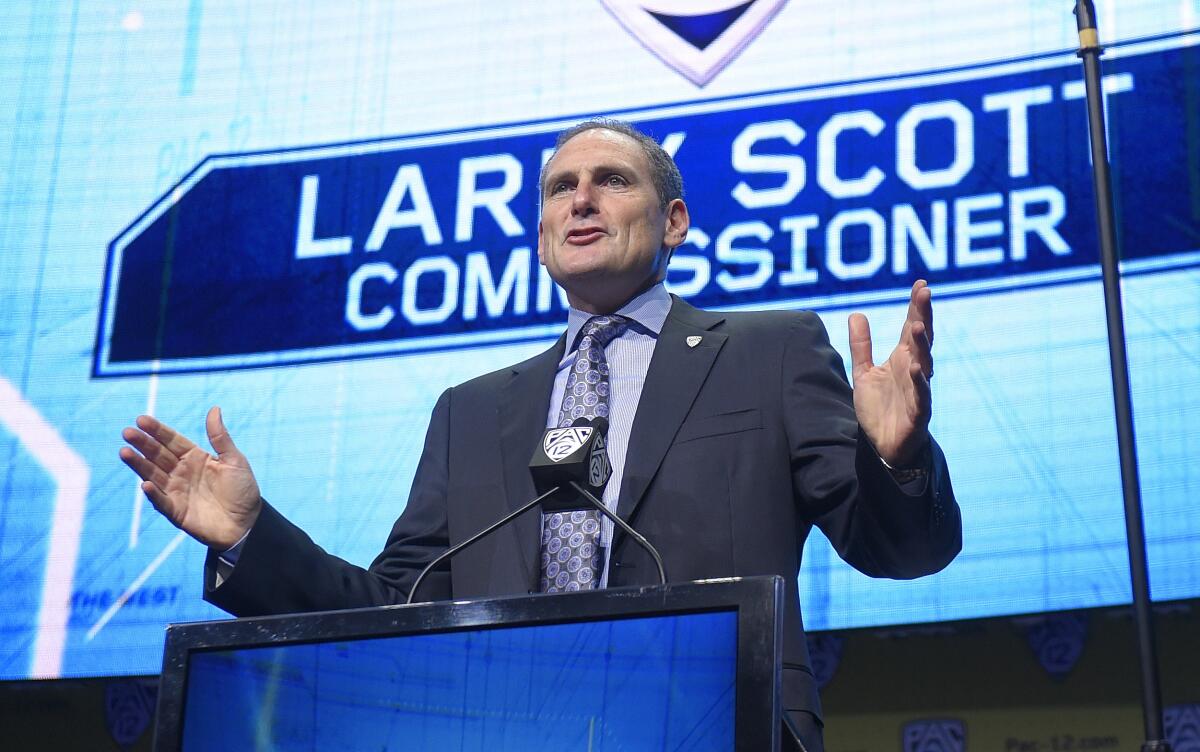
Former Pac-12 Commissioner Larry Scott. (Mark J. Terrill / AP)
Ryan Kartje (LA Times) — We’re going to step away from the football field to talk about something that every college football program could use more of these days, but never seems to get enough of:
Money.
First, let me take you back four years before the Pac-12 imploded, to when then-Pac-12 commissioner Larry Scott had a big idea to save his flailing conference.
His plan? Sell off a 15% stake of the Pac-12 to a private equity firm for a reported infusion of $1 billion, which Scott hoped would be enough to help stabilize the conference. At the time, the Pac-12’s media rights deal was only providing about $30 million per school annually. A private equity investment, Scott figured, would add tens of millions to that total, helping to hopefully keep the Pac-12 afloat until the conference’s next media rights negotiation.
But the plan never came to fruition, and the Pac-12 unraveled. The reason it didn’t work then was the presidents and chancellors of the Pac-12’s member schools had no stomach for selling off a stake in their conference to a private equity firm, no matter how desperate the conference was. USC, in particular, was one of the most vocal detractors. Viewing itself as the crown jewel of the conference, it already wasn’t happy with the equal distribution of media revenue. It saw no reason, at the time, to give away more valuable equity in its brand while locking into that arrangement for a longer period.
Had Scott managed to make that deal, who knows what might have happened with the Pac-12.
But almost seven years later, private equity firms are once again swirling like vultures overhead. As first reported last week by ESPN, USC’s new conference, the Big Ten, is now seriously considering a $2-billion private equity infusion. That deal would also reportedly lock in the conference’s members through 2046, injecting at least a little stability into an especially unstable landscape.
A decision is expected in the coming weeks, and the conference is looking for consensus among schools to move forward. But USC had no interest in such a deal before. Why would that be different now?
Well, for one, college sports have gotten a lot more expensive in the wake of the House settlement. Even before adding a $20.5 million line item to its budget, USC’s athletic expenses were among the highest in the nation at $242 million, according to the most recent Department of Education data. And that figure doesn’t consider the $200-million football facility currently being built or the millions of scholarship money that needs to be raised or the $200-million budget deficit the larger university finds itself in.
A nine-figure private equity check would go a long way in soothing those financial concerns. Especially at the Big Ten’s smaller schools. But it wouldn’t solve every revenue problem in USC’s future. And it would be foolish to think that money doesn’t come with strings attached, even if the discussed deal does at least attempt to mitigate that influence.
The deal would create a separate corporate structure that would handle all things related to revenue generation within the Big Ten. That revenue would then be distributed between 20 equity stakeholders — the 18 conference schools, the league office and this private equity firm.
So the private equity firm wouldn’t own a piece of USC athletics, so much as it would own a share of the Big Ten’s business interests. That setup would then theoretically limit the investor’s control and keep private equity out of other decisions pertaining to Big Ten athletics, which had been the fear of Pac-12 presidents when the conference previously turned up its nose to such an investment.
There are still many unknowns here, most notably how the revenue would be distributed. But there’s no reason to think the conference’s biggest brands, such as USC or Michigan or Ohio State, would sign on to any deal that didn’t include distribution of that revenue that significantly favored those schools.
That appears to be the plan. But as of now, neither Michigan nor Ohio State is on board yet.
“I believe selling off Michigan’s precious public university assets would betray our responsibility to students and taxpayers,” Jordan Acker, a member of Michigan’s Board of Regents, wrote on social media.
And in this case, the buyer has an entirely different mission than the other stakeholders involved. Private equity firms exist solely to provide up-front capital in order to eliminate risk, turn a profit and then exit the marketplace. There’s no reason to think it would be different in this case. Which doesn’t exactly jibe in the marketplace that is college athletics.
So is a $100-million check worth giving away that control? For Purdue or Rutgers, probably. For USC? I’m not so sure.
USC, like Michigan and Ohio State, has yet to sign off on plans for conference-wide private equity investment and still has questions about the potential deal, a person familiar with the decision not authorized to discuss it publicly told The Times. But the school wants to be good partners in the conference, and of course, it could always use an infusion of cash.
But does USC really need money that badly? The athletic department has already taken significant steps to raise revenue in light of the House settlement, including striking a massive, new 15-year multimedia rights deal with Learfield. USC doesn’t necessarily need the Big Ten or its new private equity partner to create conference-wide revenue streams where it could just strike deals on its own. Nor does it need assurances of the Big Ten’s long-term stability enough to sacrifice equity.
USC once made a mistake by accepting an equal share as its peers in the Pac-12. But it can’t make that mistake again. By virtue of its brand, USC is always going to have a seat at the table.
And if the Big Ten is getting into bed with private equity, it should be using every bit of that leverage to get the best possible deal. There’s no world in which USC should accept a smaller slice of that pie than Michigan or Ohio State, no matter the history of the other two.
Extra points
—Kilian O’Connor is out for at least two games with a knee injury, and maybe more. J’Onre Reed will start at center in his place. Most assumed that Reed would be the starter when he joined USC in the offseason. But O’Connor, a former walk-on, won the job in camp. Which, depending on your perspective, is either troubling for Reed or encouraging for O’Connor. Nonetheless, this is a guy who started 25 games at Syracuse. I’d hope, if USC made a point to pursue him in the portal, that Reed should be at least a passable replacement for a former walk-on. That said, the next two games — against Michigan and Notre Dame — wouldn’t have been a cake walk for USC’s offensive front even at full strength.
—Freshman All-American Caden Chittenden is getting healthier, but don’t expect him to be handed kicking duties when he returns. USC brought in Chittenden after a tremendous freshman season at Nevada Las Vegas to solve its field goal woes. But he’s been dealing with a hamstring injury since the preseason, and in his place, Ryon Sayeri has been as good as anyone could have hoped. Sayeri has hit eight of nine field goals, third-best in the Big Ten, and all 28 extra point attempts. On kickoffs, he’s been “a machine.” “If a guy is playing at a high level, no matter who it is, we wouldn’t make a change just because of that,” Lincoln Riley said last week. Don’t be surprised if he keeps the job the rest of the way, regardless of Chittenden’s status.
—USC’s top guard, Rodney Rice, will miss the next few weeks with a shoulder injury. Not ideal, obviously. But Rice should be ready to go for the basketball season opener on Nov. 3, when the Trojans take on Cal Poly. Assuming he returns to full health, he’s primed for a big season as the engine of USC’s offense.
—Former Trojan quarterback Mark Sanchez was stabbed and later arrested after allegedly drunkenly assaulting a 69-year old man in Indianapolis on Friday night. When the story was first reported, it seemed like Sanchez was the victim of a violent attack. Turns out, the police believe it was the other way around. The other man involved, a 69-year-old grease disposal truck driver, told police that Sanchez tried to break into his truck and assaulted him when he refused to move his truck from an alleyway, according to police records. The man first pepper sprayed Sanchez, then, allegedly fearing for his life, stabbed Sanchez multiple times in the chest. Sanchez was eventually taken to the hospital in critical condition, and he later told police that he didn’t know who stabbed him. He’s now in stable condition.
—The NCAA tournament is “inching closer” to expanding to 76 teams. That’s according to Yahoo’s Ross Dellenger, who reported that the expansion would likely feature a 12-game opening round in multiple cities, as opposed to the four-team “First Four” matchups which traditionally took place in Dayton, Ohio. I suppose this was inevitable, with so much TV money to be made with the tournament. But I’m not sure if anyone outside of TV execs are really clamoring for this expansion.
latimes.com
___________
TrojanDailyBlog members — We always encourage you to add factual information, insight, divergent opinions, or new topics to the TDB that don’t necessarily pertain to any particular moderator post or member comment.