



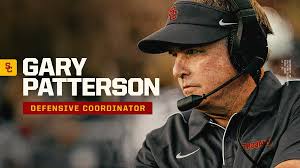

Rather than tearing down the roster, Patterson spent spring camp blending USC’s existing zone principles with his hallmark aggressive, man-match coverages.
1. Dual Play-Calling: The Split-Field Philosophy
The most transformative change Patterson introduces to Los Angeles is his independent split-field play-calling system. Unlike traditional coordinators who make one blanket call for all 11 players, Patterson issues two entirely separate calls on every down—one for the front seven and one for the backend secondary.
-
-
The Benefit: This allows the Trojans to seamlessly check into a premium run-stopping front while concurrently deploying an elite pass-coverage shell over the top.
-
The Execution: It eliminates predictable systemic weaknesses, giving USC the upper hand against complex pre-snap offensive motions.
-
2. Multiplicity but Simplicity: The Hybrid 4-2-5 Lineup
While the base formation functions as a 4-2-5, Patterson’s tactical genius relies on changing looks without changing personnel, frequently morphing into a 3-3-5 look to deceive quarterbacks.
      [DE]       [DT]       [DT]       [DE]       <-- Heavy 4-Man Front
            [LB]            [LB]                  <-- Box Linebackers
  [CB]        [WS]        [SS]        [FS]   [CB] <-- 5-DB Passing Shell
             (Weak)      (Strong)    (Free)
-
-
The Five-DB Shell: The system leans heavily on three distinct safety positions: the Free Safety (FS), Strong Safety (SS), and the “Weak Safety” (WS) or overhang nickel back. This overhang player acts as the ultimate chess piece, tasked with elite communication to seamlessly transition from deep coverage to plugging gaps in the run box.
-
Aggressive Man-Match Press: Moving away from passive zone drops, Patterson uses “40” bracket coverages. Cornerbacks press outside receivers aggressively, allowing safeties to read the eyes of inside targets and jump intermediate passing lanes.
-
3. Front-Four Freedom & Stunt Variations
Patterson’s system focuses on maximizing a deep defensive line rotation to create organic pass rushes without over-blitzing.
-
-
Four-Man Pressure: The objective is simple: rush four, drop seven into coverage.
-
Infinite Stunts: Under Patterson’s rules, the defensive line can use a single interior stunt or twist while the secondary rotates through seven different coverage variations behind it. This limits bust rates for linebackers while forcing offensive lines into sudden, difficult protection re-calls.
-
4. White-Stripe Film Teaching
To fast-track the learning curve for USC’s incoming freshman class, Patterson instituted a unique visual coaching aid during spring practices: painting bright white stripes down the center of defensive backs’ helmets. During post-practice tape reviews, this allows the coaching staff to precisely track eye discipline and verify whether safeties are staring into the backfield or executing their correct coverage reads.
Luke Wafle’s Defensive Line Projection
Wafle — the towering 6-foot-5, 260-pound five-star signee—stunned the coaching staff by completely bypassing the usual freshman learning curve during spring camp.
-
-
The Blueprint: Patterson intends to use Wafle as an “everything edge” defender. He possesses the brute lower-body power to anchor against Big Ten offensive tackles in short-yardage run situations, but his high-end hand technique allows him to compress the pocket as a pure power rusher.
-
The Rotation: Wafle is locked in a fierce battle with Penn State transfer Zuriah Fisher for starter snaps at defensive end. Even if Fisher gets the nominal nod early on, Wafle’s record-shattering high school productivity (23 sacks as a senior) and dynamic motor guarantee he will rotate in heavily on third-down sub-packages to hunt opposing quarterbacks.
-
The Overhang Nickel Safety Battle
In Patterson’s 4-2-5 system, the overhang nickel safety (often called the “Star” or “Weak Safety”) must be physical enough to fill the B-gap against the run, yet fluid enough to cover slot receivers. Post-spring practices have narrowed this battle down to two primary players with contrasting styles:
Alex Graham (The Cover Specialist): Wearing the historic No. 7 jersey, Graham exited spring with the inside track on the starting job. He brings elite lateral agility and coverage instincts to the apex, making him Patterson’s preferred option when USC faces spread offenses or heavy passing downs.